The Age of Innocence

My recent visit to New York inspired me to revisit Edith Wharton’s 1921 Pulitzer Prize winning novel; The Age of Innocence. I first read this story of New York society too many years ago to admit to, and it’s commentary on the vagaries of upper class New York passed me by. It seemed to me, at the time, to be a superficial story of unrequited romance in a classic love triangle of frivolous emotion. My, how outlooks change as we get older!

The subtleties of a fragile new society in the recently established social whirl of 1870’s New York have a certain resonance now, and I find myself comparing todays larger American society with that of Newland Archer and May Welland. Fashion, as always, plays a part in forming opinion across society. Judgements are made based on modes of dress and etiquette, today, just as they were in the 19th century. Jenny Bevan was recently judged and found wanting by some of Hollywood’s elite, for her choice of outfit at the the Oscars ceremony. Rather than conforming to accepted ‘glamorous’ dress code for the ceremony, Ms Bevan chose to homage the Mad Max film for which she so brilliantly designed the costumes. As she said to Hollywood Reporter: ” I really would look ridiculous in a gown. What I was actually wearing at the Oscars was sort of an homage to Mad Max — a kind of biker outfit.”jenny bevanJenny Bevan as part of Marie Claire’s best moments of the 2016 oscars

In Edith Wharton’s New York, the Countess Olenska , on her return to America, is haunted by her infamous appearance at her coming-out ball in black satin, rather than the customary pale colours of innocence. Her return to New York is overshadowed by the scandal of her having left her husband in Europe, ostensibly in search of a divorce; something unheard of in polite New York society. This scandal accompanies her and is emphasised in Wharton’s writing by referencing the bohemian streak to her lifestyle, and commentary on her choice of dress; a shocking ’empire line’ navy dress, worn to the Opera. Her choice of home is also under judgement by the society ladies of New York.

As one gentleman says:” I should really like to take Louisa to see her, if the neighbourhood were not so unpleasant.” Newland is dangerously enchanted by the personal touch of the decor in what Countess Olenska calls her “funny house.” What he saw meanwhile, with the help of the lamp, was the faded shadowy charm of a room unlike any he had ever known…… the vague pervading perfume that was not what one put on handkerchiefs, but rather like the scent of some far-off bazaar, a smell made up of Turkish coffee and ambergris and dried roses.” This bohemian, artistic tendency is Archer’s downfall, and he is drawn into a complicated tug of emotions between accepted genteel etiquette personified by his sweet fiancé, May Welland to whom he sends a daily box of lilies-of-the-valley, and the untouchable temptations of Countess Olenska, to whom he sends yellow roses; ” He had never seen any as sun-golden before, and his first impulse was to send them to May instead of the lilies. But they did not look like her – there was something too rich, too strong in their fiery beauty”.

yellow roses

I leave it to you to discover the outcome to this story, but as you do so, do enjoy the word pictures painted by Edith Wharton of the restrained opulence of Upper class society and the richness of the’alternative’ lifestyle of Madame Olenska. personally I can just see her wearing this wonderful embroidered coat that I saw yesterday in the V&A museum!

OLYMPUS DIGITAL CAMERA

Feathered edges

On my recent Visit to New York, I had a brief chance to look at The National Museum of the American Indian . It’s a kind of American version of the Pitt Rivers Museum in Oxford, but less chaotic. I was struck by two exhibits, one of a pair of neck collar pieces dating to AD500-1525 called Cocle necklaces, from Panama. One is made from fine hammered gold strips, the other seems to be from carved shards of bone or shell. Both give an impresion of extreme lightness and a feathered effect around the form of the necklace. bone collars


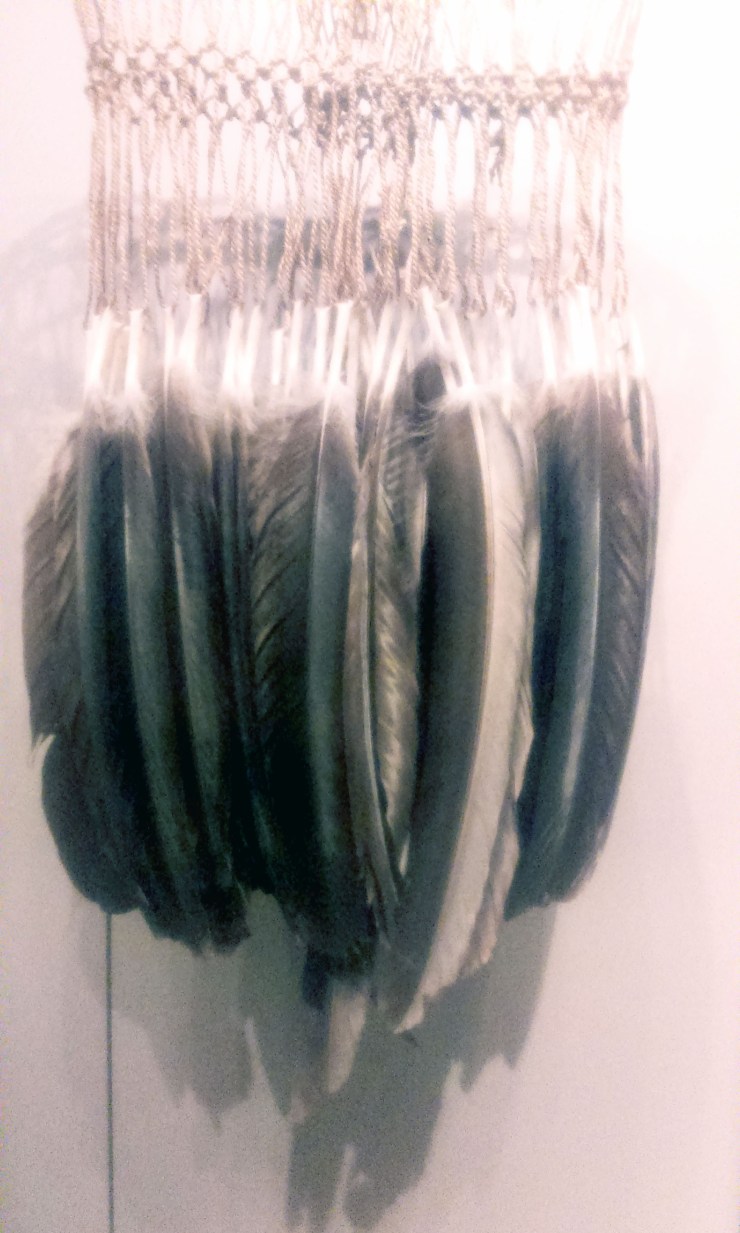
Further on in my trail around the museum I came upon this californian dance kilt/apron, made from Condor feathers and knotted twine, dating from the 1920’s -40’s. It’s funny how these things stuck in my head, and I ruminated over how I could incorporate the concept of feathers into my home furnishings collection.


feathers


And here is the result; I managed to source some rooster feathers and have used them to make a luxurious trim for the latest in my African inspired cushion collection. Combining hand tie-dyed Nigerian cloth, Yoruba beads and weaving and these lovely feathers has resulted in a real piece of luxury to add to the collection.

OLYMPUS DIGITAL CAMERA
Red and black feathered cushion

Written in glass

Over the past few years I have been gently growing my collection of traditional West African Yoruba glass beads. (There seems to be a theme for repetition and multiples growing through my posts, and I offer no apologies; this is what catches my interest at the moment!)


The Yoruba tribal land crosses the straight, ruled-line national boundaries that were imposed on Africa’s tribal regions, and spreads across Nigeria, Togo, Ghana and Benin. Coral beads are well known as a traditional Nigerian decoration and sometime currency, used for trading, dowries, chieftancy ceremonies etc. The Glass beads that I have been given come from a more recent, early 20th century evolution, in the craft of fused-glass bead making.

green:orange beads

The technique originated with the use of ground up glass bottles, which were then formed into beads by filling clay molds with the finely ground glass that is built up in layers known as the “vertical-mold dry powder glass technique”. This could be seen as a version of ‘sand painting’ when different colours of glass are used. The hole through the bead traditionally comes from the use of a cassava leaf stem, which burns away during the firing to leave the threading hole. Nowadays, the hole is often made by piercing the still hot and pliable glass with a metal tool. My bead collection is mostly made up from what are known as “Mue ne Angma” or “Writing Beads”, conventional powder glass beads made from finely ground glass, with glass slurry decorations that are being “written” on and fused in a second firing.

red:white beads


It is becoming increasingly rare to find these lovely handmade beads in the markets of Southern Nigeria, and they are fiercely protected by the stallholders.bead shop 4.jpg

As always, I am full of admiration for the craftspeople who continue these traditions, the ‘writing’ on these beads is brilliantly naïve and fine, and obviously comes from hours of painstaking work. The colours are limited by the available glass, and in the past, fragments of imported Venetian beads and coloured glass were ground to make the slurry decoration. Traditionally, yellow was the most common glass colour, with black and blue occurring very rarely. I am sure that with the proliferation of modern glass across the African continent colours are more varied now, but still there is a dominance of the earthy yellows, greens and browns picked out with vibrant colour highlights; truly a delight to my eye.

I love the idea that although each bead is an individual, each group of strung beads follow the same pattern.

Impressions of Manhattan

It is all too easy to be overwhelmed by the sheer scale of central Manhattan. Skyscraping buildings, blinding electronic billboards and towering piles of food are what we assosciate with New York City. So on my recent visit I decided to concentrate on the details, and this brought a whole new dimension to a city that I have known and loved for many years.

It is funny how, once you decide to focus on one thing, examples pop up everywhere, and so it was that I started noticing the textures in stonework, and architectural details reflected in the products on offer in shops and art exhibitions too. I think it must have looked very strange to the locals seeing this strange person taking close-up pictures in Grand central station or at the Metropolitan Museum, rather than photographing the vast architectural expanses of New york!

The simplicity of embossing, and imprinted texture needs little embellishment through colour, and perfectly fits the New York fashion week’s neutral colour trend of muted candy pink and pale smokey blue which is already in evidence in the cities home decoration collections.


Of course I was spoilt for choice, but have grouped together some of my favourite images here; mixing up the art, architecture and design of Manhattan to show the emerging trend for embossed details and pattern in my world of decoration and design.


Rooted in…..

I have been beavering away in my workspace, putting together my first collection of limited edition block printed cushion covers. The pure joy of creating a product from scratch had me literally jiggling for joy when my first lino cut printed succesfully onto the antique French linen that I have been collecting for years and wondering what to do with!!

Inspired by local London street names, I wanted to combine my love of plant drawing with my return to South London after many years living in France, and what better way than to combine them in a collection of prints? Hence the “Rooted in” collection was born! My first two designs are “Love Walk, SE5” With an image of the delicate Love-in-a-mist flower ( just in time for St Valentine’s day) and “Elm Grove SE15”. In keeping with the traditions of multi cultural Peckham and my extended family I have used traditional hand tie dyed fabric from Nigeria to create the piping around the cushions; a truly multi-ethnic product!

The first two designs in the collection went into my first stockist SE storehouse which is a social enterprise store in Peckham, and I am so excited to see my cushions in their window!

So, watch this space for more designs in the Rooted in collection, there are so many fantastic plant forms out there in the streets of London!